Your Next Career Isn’t A Path; It’s A Planned Portfolio With Purpose
Sep 21, 2026
By Laurel Donnellan (originally published at Forbes.com)
When I started my career, planning meant one thing: go to college, pick a ladder, climb it. Choose a field, get a job, get promoted, retire. The plan was linear because the world of work was, too.
That world is gone.
Full-time jobs now sit alongside freelance work, gig income, entrepreneurial side projects, sabbaticals, layoffs, caregiving pauses, and pivots nobody saw coming. And yet most of us are still handed the same old tool for navigating it: a single-track resume and a plan that assumes none of that will happen.
It will.
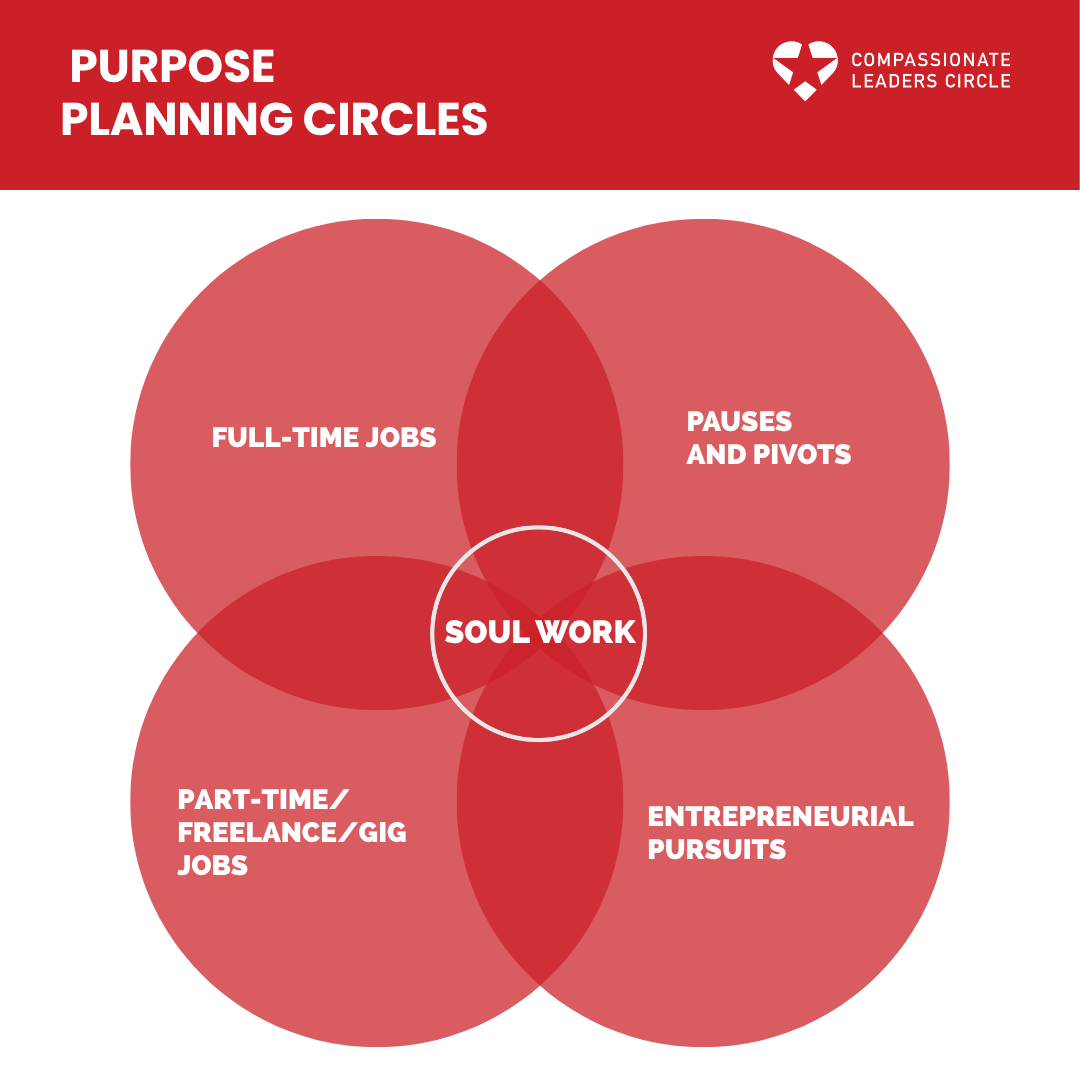
So at Compassionate Leaders Circle, we built something new and different — a model we call Purpose Planning Circles. It doesn’t ask you to pick a lane. It asks you to build a life while readying yourself for change.
The Center Of The Model: Soul Work
Every version of career planning I’ve encountered starts with the job. Ours starts with something more aspirational, which we call Soul Work — the best use of your passions and purpose for whatever chapter of your career you’re in right now. So to identify Soul Work, you need to spend time clarifying your passions and purpose.
Let’s start with a practical tutorial on passions. We break passions into four categories: your interests (what energizes your mind), your talents (the skills you’d never delegate to someone else), your style (how you act when you’re being fully yourself), and your environment (the conditions you need to do your best work). Most people can name one or two of these easily. Almost nobody has sat down and named all four — which is exactly why so many talented people end up in the right industry doing the wrong job.
The second part of Soul Work is purpose. Purpose is a declaration of contribution based on the values that will propel you to your vision. Your vision can be simple, like I want to enjoy going to work, or complex, like, I want to create an AI engine that creates jobs for people under 25. Purpose will reflect your deeper why, such as “I value my mental health and want to show my kids that they can love their work.” or “I want to use my expertise around AI to dampen the fears of young people.”
Soul Work is also not static. It’s your why right now, not your why at 22 or your why at 60. That’s a relief, not a burden: you’re allowed to revise it.
Four More Circles
Around that center, we draw four overlapping circles, each representing a different way to generate income and/or meaning:
Full-time jobs. Working for an employer — still, for most people, the most stable circle, and according to the Bureau of Labor Statistics, these opportunities will shrink over the next ten years.
Part-time, freelance, and gig work. Independent-contractor income that offers flexibility the traditional job often can’t. This segment is growing.
Entrepreneurial pursuits. Building a product, service, business, or investment income of your own.
Pauses and pivots. The circle almost every career model leaves out — education, layoffs, health issues, childbirth and rearing, caregiving, burnout, retraining, grief, sabbaticals, spiritual epiphanies. These aren’t detours from a career. They’re part of it.
The insight isn’t that you should choose one circle and defend it for 30 years. It’s best to explore all four. These circles overlap, and the overlap is where sustainable careers actually live. If you have a business idea, it’s often smart to take a job at a similar company first, to learn the field while you build your plan — working two circles at once to de-risk the leap. If your industry is being reshaped by AI, freelance work might be the bridge between the job you’re leaving and the one you haven’t found yet. The strategy isn’t sequencing your circles. It’s layering them.
And the fifth “circle” — Pauses and Pivots — isn’t optional. Anticipating it in advance is what separates people who bounce back from a layoff or a health scare as quickly as possible without losing themselves in the process. Ask yourself now: what habits — financial, physical, relational — would make my next unplanned pause easier to weather? Then start building them before you need them, not after.
Dream First, Then Get Specific
Once you have a sense of your Soul Work (it does not have to be complete and perfect) and which circles you want to build or strengthen, then you will begin planning—starting with a five-question sequence:
1. What’s your current work portfolio, and what’s actually working in it?
2. What’s your long-term vision for the next three to ten years, income included?
3. What’s your short-term vision for the next six months to a year?
4. What three specific actions will you take in the next 30 days toward that vision?
5. And — critically — what three specific actions will you take in the next 30 days to better prepare for your next pivot or pause?
Notice that last question isn’t an afterthought. It’s load-bearing. A career plan that doesn’t account for interruption isn’t a plan; it’s a bet that nothing will go wrong.
Why This Matters More Now, Not Less
It’s easy to read this as a nice framework for a calmer decade. It’s actually most useful in this one. AI is compressing timelines, automating tasks inside roles that used to feel permanent, and forcing a level of reinvention once reserved for mid-career crises. People at every stage — from Gen Z workers building fluency alongside foundational skills, to Gen X leaders governing how their teams use these tools — are being asked to hold more uncertainty than their career models were built for.
The instinct in that environment is to grip the ladder tighter. The better instinct is to broaden what counts as progress. Meaningful work isn’t just correlated with well-being and stronger relationships — research consistently ties it to productivity, retention, and even longevity. That’s not a soft argument for chasing purpose. It’s a hard one.
Start With One Question
You don’t need to overhaul your career this week. You need to answer one question honestly: what is the best use of your passions or purpose for your next chapter? Write it down. Then look at your four circles—jobs, freelance work, entrepreneurship, and the pauses you haven’t planned for—and ask which combination supports the answer you just wrote.
The ladder was never coming back. The circles were there all along; we are just shining a light on them. If you are interested in designing a career you will love, join us at our next Plan for Purpose group, launching on October 14th.
Stay connected with news and updates!
Join our mailing list to receive the latest news and updates from our team.
Don't worry, your information will not be shared.
We hate SPAM. We will never sell your information, for any reason.